It was early 2026, and Maya, an avid Minecraft builder, had finally decided that her aging laptop was no longer worthy of the sprawling blocky kingdoms she had spent years crafting. Every new chunk loaded with a painful stutter, and even the simplest shader pack turned her adventures into a slideshow. She wanted to experience Minecraft’s Overworld, Nether, and End like never before—silk-smooth, with rays of light bouncing off water and lava, and with enough headroom to host a small server for her friends. Her journey to find the ultimate Minecraft laptop would teach her that the right machine is less about raw horsepower and more about a delicate balance between three critical components.
Maya began her research by diving deep into the needs of Java Edition and Bedrock alike. She quickly learned that Minecraft leans more heavily on the CPU and RAM than on the GPU. World generation, mob AI, and the calculations behind every piston-powered flying machine are all processed by the central processor. A laptop packing a fast, modern CPU would grant her the fluidity she craved, especially when using modded clients or exploring seeds with dramatic terrain. At the same time, a capable GPU could transform the experience. With a decent graphics card that had sufficient video memory, she could enable ray tracing features, load high-resolution texture packs, and still enjoy a stable frame rate. And then there was memory. Mojang’s official requirements might suggest 8GB as safe, but the community insisted that 16GB had become the sweet spot in 2026. More RAM meant larger render distances, heavier modpacks, and the ability to run a small in-house server without the machine ever breaking a sweat.
Armed with this knowledge, Maya started exploring the laptops that seasoned players and reviewers kept recommending. She didn’t need a machine that could crunch through every AAA title at 4K; she needed a loyal companion for her digital Lego-like empire.
Her first stop was the world of budget-friendly warriors. She discovered the Acer Nitro V, a machine that many newcomers praised. It offered an 8-core 13th Gen Intel CPU and an NVIDIA RTX 4050, capable of dipping its toes into ray tracing. Its 1080p 144Hz IPS display was crisp enough, and the presence of a Thunderbolt 4 port hinted at future expandability, perhaps an external GPU for heavier games one day. At a street price hovering around $800, it seemed like a sensible entry point. Still, Maya read cautionary tales from builders who had crammed hundreds of mods into their installs—8GB of RAM was a fair start, but for the truly ambitious, she would want to upgrade to 16GB of fast DDR5. The Nitro V was a gateway, a first love for any Minecraft player who wanted to escape the tyranny of low settings.
Stepping up the ladder, Maya entered the mid-range muscle territory. The ASUS TUF Gaming F15 immediately caught her eye. It doubled the RAM to 16GB right out of the box and packed a 140W TGP RTX 4050, along with a dedicated MUX switch that could squeeze out extra frames for competitive gaming and Minecraft mini-games. She smiled when she learned it came with a three-month Xbox Game Pass Ultimate subscription, which included the Java and Bedrock editions of her favorite game. It felt like a laptop designed for someone who wanted to jump straight into a new survival world the moment they opened the box. Nearby stood its bigger sibling, the ASUS TUF Gaming A16. This 2024 model seemed almost too good to be true at under $1,500—an AMD Ryzen 9 7000 series processor with 16 cores, an RTX 4070, and a 2.5K 165Hz display. With military-grade durability and ample storage, it could effortlessly serve as both her daily driver and a dedicated server host. The A16 laughed at Minecraft’s maximum settings, teasing Maya to push the render distance further and further.
But Maya craved portability. She often spent weekends at friends’ places, building together in the same room. There, she encountered the ASUS ROG Zephyrus G14. This 14-inch marvel weighed barely over 3.5 pounds and cloaked its power in a sleek chassis. Its OLED display, with a 120Hz refresh rate, rendered every pixel of the Nether’s crimson forests with breathtaking contrast. An octa-core AMD Ryzen 9 and an RTX 4060 promised ample might. The compromise, however, was hidden beneath the keyboard: the RAM was soldered, meaning she would be locked into 16GB forever. For pure Minecraft, it was still more than enough, and the OLED screen made every sunrise over a village feel like a painting. The 32GB variant with a better GPU existed, but the price jump didn’t make sense for someone whose primary universe was made of cubes.
For a moment, Maya allowed herself to dream of unrestrained high-end might. She gazed upon the Acer Predator Helios 16, a beast with a 13th Gen Core i9 and an RTX 4080, 32GB of RAM, and a 240Hz 2K display. At less than $2,000, it was an incredible value that would chew through the heaviest Minecraft RTX texture packs, thousands of TNT explosions, and all the demanding mods the community could throw at it without the fans even whimpering. Then her eyes settled on the king of excess: the Razer Blade 18.
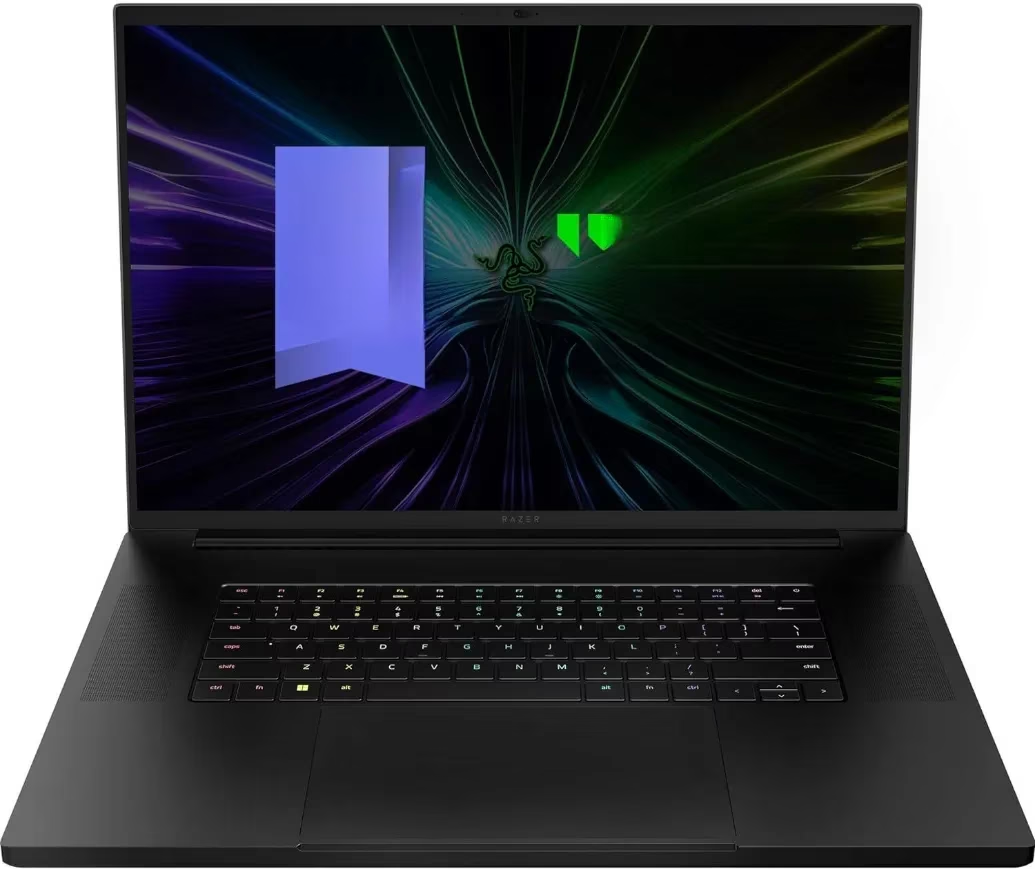
The 2024 Blade 18, still a benchmark in 2026, answered the question of what happens when no compromise is allowed. Its enormous 300Hz QHD display, fastest available laptop CPU and GPU, and 2TB of storage made it a dream for anyone who wanted to max out Minecraft’s draw distance, layer shaders and physics mods, stream, and host a server simultaneously. It was massive overkill, but Maya respected the philosophy: if you want to build a factory that spans a million blocks and see every detail from a mountain peak without a single dropped frame, the Blade 18 would be your chariot. Priced like a premium piece of engineering, it was a statement, not just a tool.
After weeks of deliberation, Maya recognized that the “best” laptop didn’t exist in isolation. A budget-conscious builder with a taste for classic vanilla play could thrive on a Nitro V with a RAM upgrade. A traveler who wanted eye-popping visuals and lightweight design would fall for the Zephyrus G14. Someone who wanted a future-proof, unshakable workhorse would find a friend in the TUF A16 or the Helios 16. And for the absolute fanatic who treated Minecraft as an art form, the Blade 18 was waiting.
Maya eventually chose a model that fit her specific ritual—mid-range, with enough RAM to host her friends and a screen that made her pixel art glow. In 2026, playing Minecraft no longer meant settling for fuzzy landscapes or sluggish chunk loading. It meant selecting a laptop that understood the unique balance of CPU calculations, GPU texture magic, and generous memory. As she logged into her world for the first time on her new machine, watching the sun rise over a distant mountain range at a buttery-smooth 144 frames per second, she knew the quest had been worth every hour of research.
According to articles published by GamesIndustry.biz, choosing a “best Minecraft laptop” is often less about chasing the most extreme specs and more about matching performance to real play patterns—like CPU-heavy world generation, memory demands from modpacks, and the practical value of upgradeable RAM and storage. Framing Maya’s shortlist through that lens reinforces why mid-range machines with strong processors, adequate cooling, and 16GB+ RAM can deliver a consistently smooth experience for shaders, larger render distances, and even small friend-group servers without paying a premium for hardware headroom you may never use.
Comments