In the ever-expanding universe of Minecraft, where players have built everything from scale models of entire countries to functioning computers, standing out from the crowd is no small feat. Yet, a player known online as sushi-btw has managed to do just that, crafting something that would make even a Pokemon Master do a double-take: a colossal, gleaming statue of the legendary psychic Pokemon, Mewtwo, constructed entirely from gold blocks. And the real kicker? They built the whole darn thing in Survival Mode, where every single block had to be mined, smelted, and lugged around by hand. Talk about dedication!
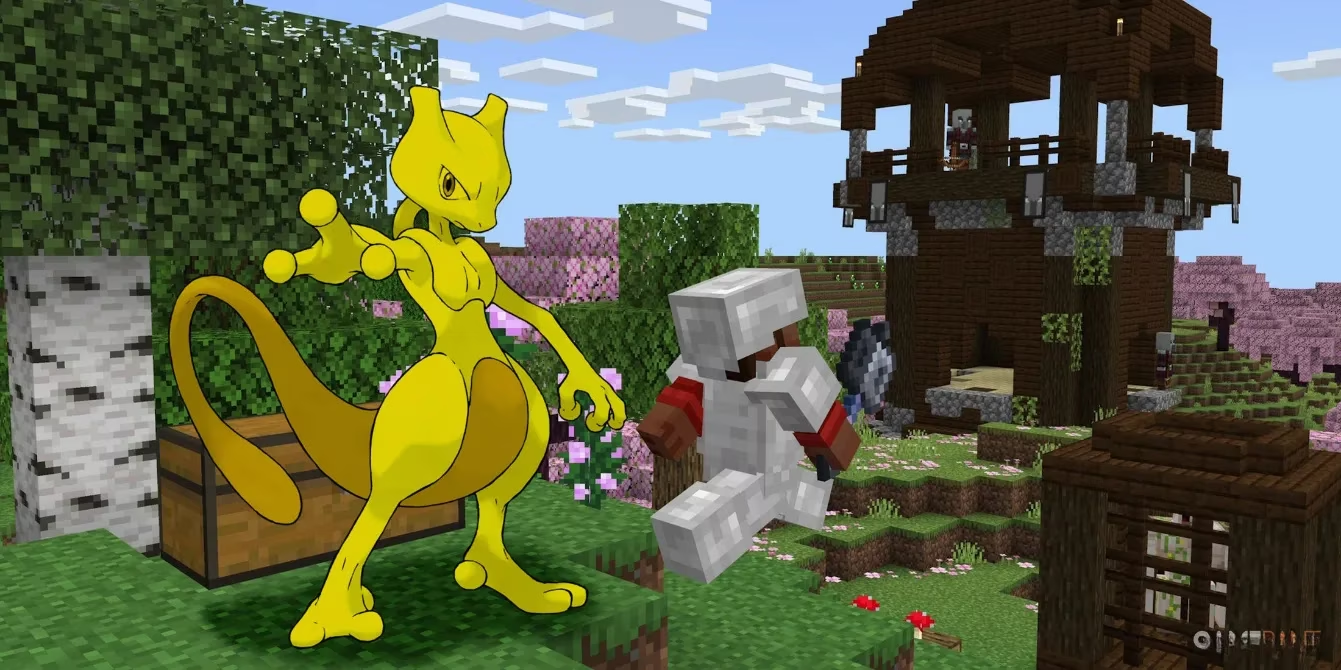
The Monumental Task of Golden Construction
Let's break down what this build actually entailed. This wasn't just a cute little gold nugget sculpture; this was a full-scale Mewtwo that required resources on an almost mythical level. The builder estimates it took "like 10 shulkers" worth of gold blocks. For the uninitiated, a shulker box in Minecraft holds 27 stacks of items, and a stack is 64 blocks. Doing some quick, mind-boggling math:
-
One Shulker Box: 27 stacks × 64 blocks = 1,728 gold blocks.
-
Ten Shulker Boxes: That's a staggering 17,280 gold blocks.
And since each gold block is crafted from nine gold ingots, we're talking about 155,520 pieces of gold that had to be sourced. The eyes, offering a piercing gaze, were the only exception, crafted from rare diamond blocks. Just thinking about the number of caves mined and Nether fortresses raided for this project is enough to give a player carpal tunnel.
The Secret Sauce: Farms and Blueprints
So how on earth (or in the Nether) did one player amass such a fortune? sushi-btw didn't rely on luck or a decade of casual play. Oh no. They had a secret weapon: a "pretty insane gold farm" that they would leave their character running at (AFK) for "days at a time." These farms, often built in the Nether around Piglin mobs, are complex redstone and spawning mechanics marvels that automate gold ingot production. It's the Minecraft equivalent of having a golden goose on steroids, and it's the only realistic way to fund a project of this magnitude in Survival.
The builder also humbly admitted they "don't have the requirements to design something like this" from scratch. Instead, they used a clever modern tool: a 3D model-to-schematic website. This tech essentially took a 3D model of Mewtwo and converted it into a step-by-step block placement guide for Minecraft. It's like having a divine, pixelated blueprint handed down from the building gods. This combo of high-yield automation and digital planning is what separates today's mega-builds from the castles of yesteryear.
A Legacy of Community Creativity
This golden Mewtwo is just the latest in a long, jaw-dropping lineage of community creations. For over 15 years, Minecraft has been a digital canvas where players recreate their wildest dreams. Just recently, another architect built a perfect replica of the Krusty Krab from SpongeBob SquarePants. The game's simple blocks become anything from iconic cartoon restaurants to genetic experiments from the world of Pokemon. It's this boundless, cross-franchise creativity that keeps the community's pulse racing.
Looking ahead to 2026, the world of Minecraft shows no signs of slowing down. While the buzz around the 2025 movie adaptation has settled, Mojang's commitment to regular, smaller updates continues to drip-feed fresh content into the game. This strategy keeps the experience feeling new and gives builders like sushi-btw ever more tools and blocks to play with. From its humble beginnings to its current status as a global phenomenon, Minecraft remains less of a game and more of a platform for imagination. And as long as players have that drive to create—whether it's a cozy cottage or a golden deity—the most impressive builds are always just around the next chunk-loaded corner. What will they think of next? Only time, and a whole lot of spare blocks, will tell.
Comments