As a dedicated player who has witnessed Minecraft's evolution firsthand, I can confidently say that the game's most recent experimental snapshots have delivered something truly exciting: a potential revival for one of its most iconic yet long-neglected features. For years, the humble minecart has languished in the shadow of the elytra, its complex rail networks and substantial resource costs making it a relic of a bygone era. Who among us hasn't built sprawling railways, only to abandon them once we earned our wings? The convenience of flight simply outclassed everything else. But now, in 2026, Mojang is laying the groundwork for a dramatic comeback, and the changes are nothing short of transformative.
The Foundation of a New Era
The pivotal moment arrived with snapshot 24w33a. While the headline grabber was the bundle's reintroduction, the real game-changers for builders and engineers were two fundamental adjustments to minecart mechanics. First, and most crucially, minecarts now maintain vertical momentum. This means when a cart rolls off a vertical slope, it doesn't just plummet straight down like a stone. Instead, it continues on a graceful diagonal trajectory before gracefully tilting back to meet the ground. This single change opens up a world of new possibilities for rollercoaster designs and complex launch systems that were previously impossible.
Second, Mojang introduced a powerful new gamerule that directly controls minecart speed. The default is set to a familiar 8, but the ceiling has been blown off—it can now be adjusted all the way up to a staggering 1000. To put that in perspective, that translates to a theoretical speed of 1000 blocks per second. Imagine crossing an entire Minecraft world in mere moments! While such extreme values are clearly for creative experimentation, the very existence of this adjustable rule signifies a new philosophy: minecart travel should be customizable and powerful.
Unleashing Player Ingenuity
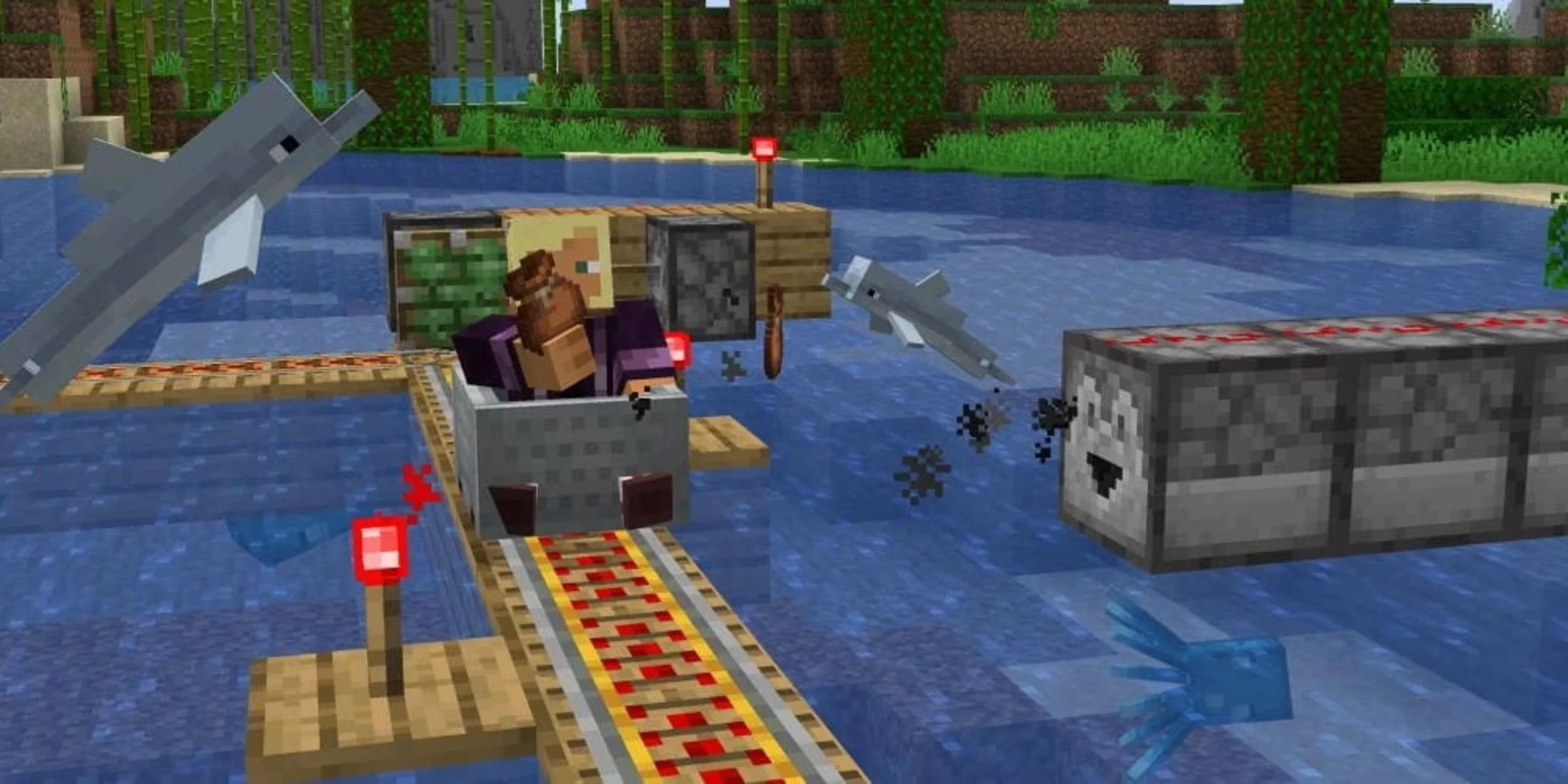
So, what happens when you combine preserved momentum with insane speed limits? Players, being the brilliant engineers they are, have already created marvels. The classic setup involves a simple rail loop where a minecart accelerates to maximum speed. With a flick of a lever, the track is diverted onto a slope. The cart, carrying its passenger or cargo, rockets off the end, launched into the sky like a projectile from a railgun. It's a breathtaking display of physics and redstone, a pure expression of player creativity that was stifled by the old, rigid mechanics.
Is this just a toy for creative mode? Not necessarily. The underlying principle—using momentum and controlled launches for efficient transport—has direct applications in survival. Think about quickly traversing difficult terrain like mountains or oceans. A well-designed launch cannon could become a legitimate, exciting alternative to bridging or boating.
A Clear Vision for the Future
Mojang's patch notes for these snapshots are remarkably candid. They state that these minecart changes are intended as a 'foundation' for future development, with the ultimate goal of making minecarts 'viable' once more. This isn't just a few tweaks; it's part of a comprehensive rework of the minecart's underlying physics and how it interacts with the world. This work continued into snapshot 24w34a, showing a committed, ongoing effort to revitalize this classic mode of transport.
The focus extends beyond just fun and games. These changes are deeply tied to improving Minecraft's parity between its different editions and refining the often-tricky redstone system. By rebuilding the minecart from the ground up, Mojang is creating a more stable and predictable foundation for all the complex machinery that players love to build.
The Road Ahead: Challenges and Opportunities
Let's be honest, though. Even with these fantastic new physics, the minecart still faces stiff competition. A well-bred horse with a good saddle can be faster and more flexible over rough terrain without requiring any infrastructure. For minecarts to truly reclaim their place in the meta, a few key improvements are still needed:
-
A Base Speed Increase: The default speed could use a modest bump to make basic railways more appealing for medium-distance travel.
-
More Accessible Powered Rails: The resource cost for powered rails (gold, redstone) is a significant barrier. We already can salvage regular rails from mineshafts—why not extend this generosity?
-
Idea: Allow players to find small quantities of powered rails in new structures like ancient workshops or librarian outposts.
-
Idea: Introduce a new, slightly less efficient but cheaper-to-craft rail type for early-game acceleration.
-
-
Integration with New Features: How might minecarts interact with the upcoming archaeology system or new biomes? The potential for themed railways is huge.
| Transport Method | Pros (2026) | Cons |
|---|---|---|
| Elytra | Unmatched point-to-point freedom, high speed with rockets. | Requires endgame access, consumes fireworks, tricky to master. |
| Horse | Good speed over land, no fuel cost, can jump. | Requires breeding/taming, pathfinding issues, can't cross water. |
| Minecart (New) | Predictable physics, insane speed potential (gamerule), safe enclosed travel. | High initial resource/construction cost, requires tracks. |
| Boat on Ice | Extremely high speed on prepared paths. | Massive, boring construction project for highways. |
Conclusion: All Aboard!
The message from Mojang is clear: they haven't forgotten the minecart. These experimental snapshots are a love letter to the builders, the engineers, and the players who remember the joy of their first rollercoaster. By reworking the core physics and giving us tools to control speed, they've planted the seeds for a transport renaissance. Will it be enough to dethrone the elytra? Perhaps not entirely, but it doesn't need to. The goal is to make minecarts a compelling, fun, and strategic choice once again. For the first time in years, I'm genuinely excited to lay down some track and see where these new carts can take me. The future of Minecraft travel is looking faster, smarter, and a whole lot more dynamic.
Comments