In the cinematic landscape of 2026, the legacy of A Minecraft Movie remains a fascinating case study in the chasm that can exist between professional critique and public adoration. Released in 2025, the film, directed by Jared Hess, was met with a reception as blocky and divided as the iconic cubic world it brought to life. While critics sharpened their pens, audiences, particularly families, flocked to theaters, creating a box office phenomenon that proved some stories are built not for reviewers, but for players. This disparity became the film's defining narrative, a tale of two audiences viewing the same screen through entirely different lenses.
The Critical Consensus vs. The Audience Celebration
From its very first previews, A Minecraft Movie established a polarizing dynamic on review aggregator sites. The critical Tomatometer solidified at a lukewarm 47%, painting a picture of a film deemed creatively flat. Many reviews described it as a predictable, by-the-numbers adaptation that failed to mine the deeper, more surreal potential of its source material. For them, the film was like a perfectly rendered, yet ultimately empty, digital diorama—impressive in scale but lacking a soul.
In stark contrast, the audience Popcornmeter soared to an enthusiastic 83%, based on thousands of verified ratings. This wasn't a minor gap; it was a canyon. The primary drivers were clear: families and the game's legion of young fans. For this demographic, the film was a vibrant, kinetic playground. It successfully translated the game's sense of boundless creation and lighthearted adventure into a cohesive, kid-friendly narrative. The movie operated like a well-crafted, multiplayer server set to "creative mode"—a safe, collaborative space designed for fun and spectacle over complex challenge.
Box Office Gold in a Cubic World
The audience's verdict translated into immediate financial success, silencing any doubts sown by mixed reviews. A Minecraft Movie carved out a place in history by earning the highest Thursday preview total for any video game adaptation ever, a record it still holds in 2026. This powerhouse opening signaled a hunger for the property that critics had underestimated. Projections of a $70-90 million domestic opening weekend were not only met but in some markets exceeded, providing Warner Bros. with a much-needed blockbuster win. The film's performance demonstrated that in the modern era, a strong, targeted audience connection could propel a project to success independently of critical acclaim. Its journey to profitability against its $150 million budget was less a desperate sprint and more a steady, assured march, fueled by weekend family outings.
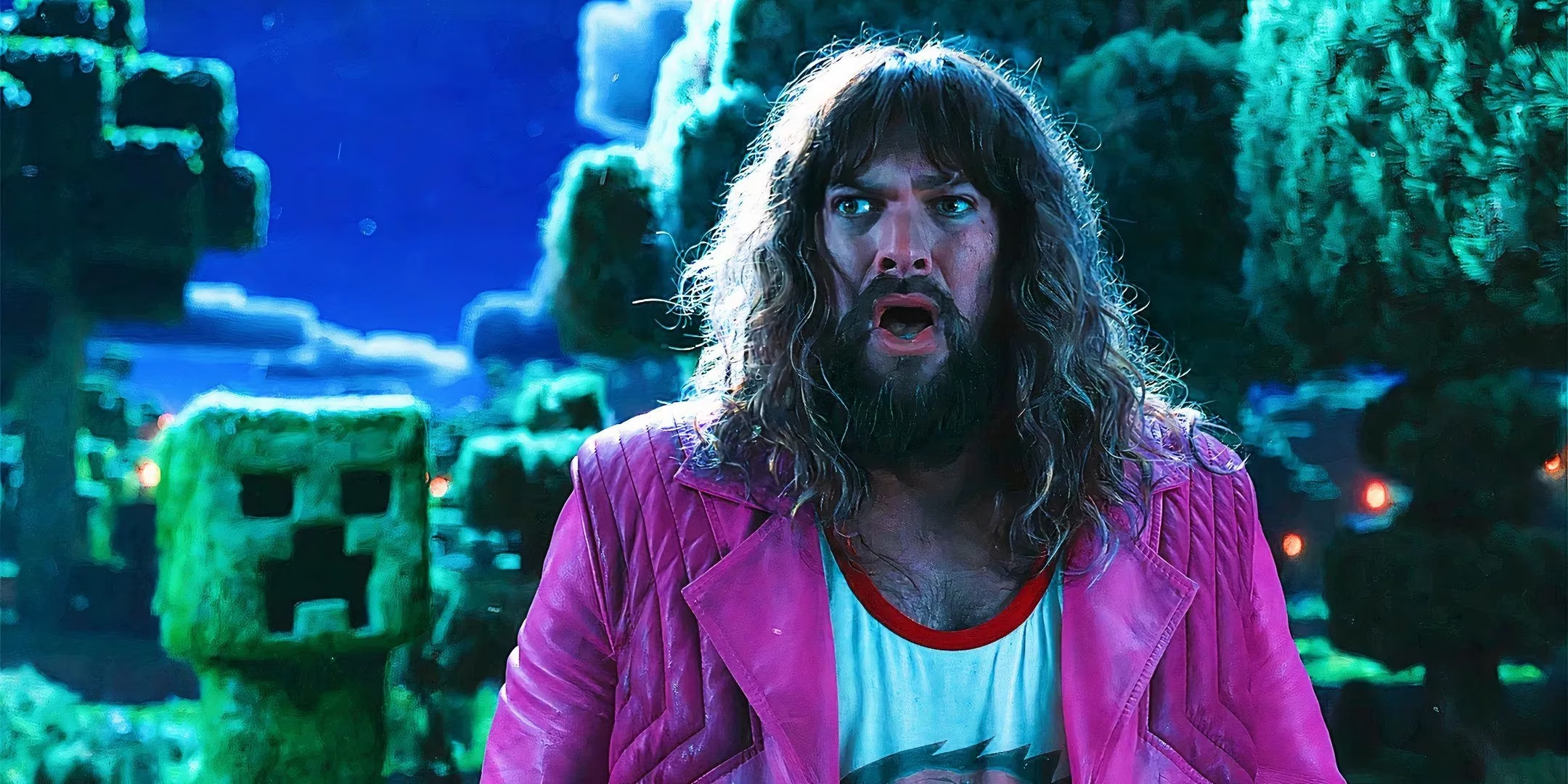
The film balanced family-friendly adventure with the game's iconic, tense moments.
Why the Divide? Understanding the Target
The core of the divide lies in the film's unambiguous target. The movie was squarely aimed at a young audience, a fact every element of its marketing and execution reinforced. Critics, often assessing film through a lens of narrative innovation, thematic depth, and cinematic craft, found little to grasp. The plot—following four outsiders who must navigate the Overworld with the help of crafter Steve (Jack Black)—was serviceable but uncomplicated. The humor was broad, and the emotional beats were clear and simple.
For its intended viewers, however, these were features, not bugs. The film was a kiddie-friendly popcorn movie, a genre that prioritizes accessibility, color, action, and joy over subtext. It was like a brilliantly packaged toy box: to an adult, it might seem like a collection of plastic parts, but to a child, it is a universe of possibility. The negative reviews, while understandable from a traditional critical framework, ultimately bounced off the film's target demographic like an arrow hitting a block of obsidian.
The Cast and Creative Sandbox
The film leveraged its cast effectively within its family-adventure framework. Jason Momoa and Jack Black brought a palpable, energetic chemistry that resonated with viewers. Their performances were big and engaging, perfectly suited for a film that felt, in its best moments, like a live-action cartoon. Director Jared Hess, known for his work on Napoleon Dynamite, applied his signature eye for quirky, character-driven comedy to the blocky universe, even if the constraints of a major studio franchise limited his more idiosyncratic tendencies.
| Aspect | Critical View (47% Tomatometer) | Audience View (83% Popcornmeter) |
|---|---|---|
| Narrative | Bland, formulaic, lacks depth | Fun, easy to follow, exciting adventure |
| Humor | Juvenile, simplistic | Hilarious, perfect for kids |
| Visuals | Faithful but uninspired | Colorful, amazing, brings the game to life |
| Overall | A missed opportunity | A fantastic family movie night |
Legacy and Lasting Impact
As of 2026, A Minecraft Movie stands not just as a film, but as a cultural artifact that highlights a shifting paradigm in entertainment consumption. Its success proved that a direct, heartfelt connection with a core fanbase could be the most powerful engine for a franchise. The critical negativity, while a footnote in many reviews, did little to dampen its commercial and popular triumph. The film was like a viral crafting tutorial: ignored by traditional media outlets but celebrated and shared millions of times within its community.
Its performance paved the way for a more confident approach to video game adaptations, showing studios that faithfulness to a game's feel and spirit for its players could be more valuable than transcending the source material for universal acclaim. The movie worked because it understood its assignment: to be a gateway into the Minecraft universe for a new generation, and a celebration of it for existing fans. In that mission, judged by the smiles in theaters and the robust box office returns, it was an unqualified success.

The poster promised the adventure that audiences enthusiastically embraced.
Ultimately, A Minecraft Movie is remembered not for the reviews it received, but for the experience it delivered. It built a bridge between a digital phenomenon and the shared magic of the cinema for families around the world, proving that sometimes, the most important score isn't on a critic's site, but in the collective imagination of its audience.
Comments